

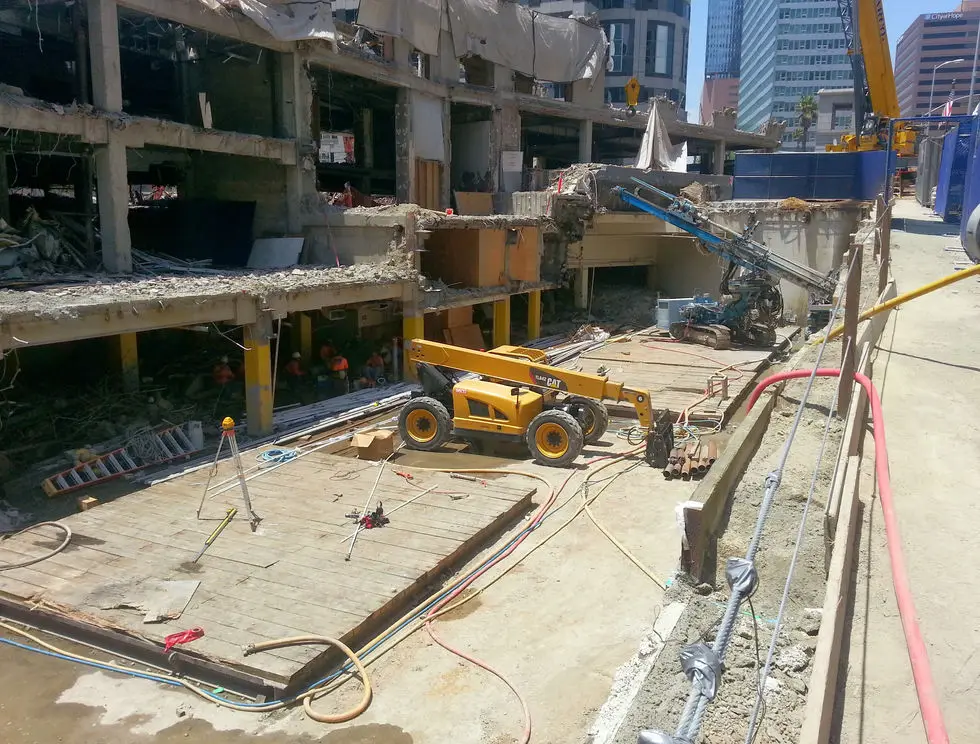
Monitoring can track how shoring and neighboring structures respond as piles are installed, excavation deepens, and bracing changes. The measurements help the responsible engineers compare observed behavior with the project's criteria and assess whether further review is needed.
Cefali's Los Angeles projects include real-time instrumentation around Metro tunnels at Wilshire Grand, monitoring of shoring and existing structures at Century Plaza, and movement monitoring during pile installation beside a brick building at TEN50. The activity and structure being observed determined where monitoring was needed.
Wilshire Grand: instrumented support beside Metro tunnels
At Wilshire Grand Center, the tower excavation extended 98 feet below Wilshire Boulevard. The system included seven rows of tiebacks, with preloaded rakers at and below the nearby Metro tunnel level.
Tiebacks, rakers, soldier piles, and tunnels were instrumented to monitor excavation movement in real time. Monitoring accompanied a support design shaped by the sensitive infrastructure beside it.
A published ASCE case study also describes the tied-back system and lower raker bracing where subway tunnel geometry constrained the anchor layout. The support arrangement and the monitoring addressed the same excavation, with the instruments providing information as construction proceeded.
Century Plaza: the existing hotel remained within the redevelopment
At Century Plaza in Century City, excavation reached about 70 feet at the deepest tower mat foundations. Temporary cantilever piles, tiebacks, and preloaded rakers supported the work while the existing hotel remained part of the redevelopment.
Tiebacks, rakers, soldier piles, and existing structures were outfitted with real-time instrumentation for monitoring shoring performance. The project also required coordination with deep street utilities, future Metro work, multiple review groups, and existing structures.
Where several structures and construction activities are involved, readings need to reach the responsible structural, geotechnical, shoring, and construction teams. The monitoring plan should establish who reviews each set of data and how changes will be assessed.
TEN50: monitoring began during pile installation
At TEN50 in Downtown Los Angeles, a three-level excavation was constructed beside an existing brick building. Monitoring tracked movement during pile installation, before the excavation reached its full depth.
The site also had deep wet and dry utilities and a communications vault immediately beside the shoring bulkhead. The surrounding construction mattered during installation as well as during the later cut.
Monitoring may therefore be needed at several stages: pile installation, anchor stressing, excavation, dewatering, brace installation, or removal of temporary support. The relevant stages depend on the adjacent condition and the support design.
The starting condition gives later readings context
Baseline information can include survey readings, existing-condition records, crack surveys, and initial instrument readings. The responsible professionals determine what is needed and collect it before the construction activity being monitored.
That baseline helps distinguish changes during the work from conditions already present. Instrument locations and reading frequency also need to suit what is being observed, whether wall movement, settlement, an adjacent building, or a tunnel.
Each project needs its own criteria based on the structures, ground conditions, and shoring. The instruments and movement limits used on one excavation cannot simply be carried over to another.
Readings need a defined review and response
The monitoring plan should identify who installs and maintains the instruments, who collects and reviews readings, how often review occurs, and which project members receive the results. It also needs project-specific triggers for further assessment and clear authority for any change to construction operations.
That process should continue through the relevant changes in support, including the transition to permanent construction. Monitoring during initial excavation may not cover the conditions when a brace is removed or a new floor takes over support.
Temporary shoring and any required underpinning still provide the structural support. Instruments measure behavior; they do not carry the loads or replace assessment of a neighboring foundation. The guide to excavation beside existing buildings explains that relationship.
Planning monitored excavation beside a building or transit structure
Contact Cefali & Associates with the excavation and shoring drawings, geotechnical report, adjacent-structure information, and any monitoring criteria issued by the project team or reviewing agency. Include existing-condition reports and baseline readings if available.
Identify the construction activity causing concern, such as drilling beside a brick wall or excavating near a tunnel. That helps establish how the shoring work should relate to the monitoring program and which specialists need to provide and review the measurements.