Tiebacks around below-grade work
Most Intuit Dome shoring used cantilever and tieback-braced soldier piles. The design also accounted for construction access and loads from cranes, concrete pumps, and lifting equipment around the excavation.
 Cefali& AssociatesContact
At Intuit Dome in Inglewood, tieback-braced soldier piles supported below-grade arena construction alongside cantilever piles. Cefali & Associates and Malcolm Drilling worked together on the shoring, including an entrance tunnel where tieback agreements could not be secured.
Tiebacks support the wall from the ground behind it, leaving working space inside the excavation. Their usefulness depends on where anchors can actually extend. Property rights, underground obstructions, ground conditions, and drilling access can change the support arrangement along a single site.
Site conditions
Most Intuit Dome shoring used cantilever and tieback-braced soldier piles. The design also accounted for construction access and loads from cranes, concrete pumps, and lifting equipment around the excavation.
Where tiebacks were unavailable, cross-lot braces carried the entrance-tunnel support loads from within the site. The braces were placed above truck traffic, keeping their structural role compatible with the construction route below.
Internal braces occupy space that anchors leave open. Their locations therefore need to fit excavation, foundations, and vehicle clearance. The engineering layout uses the property rights available to the project; it does not establish those rights.
Published project work
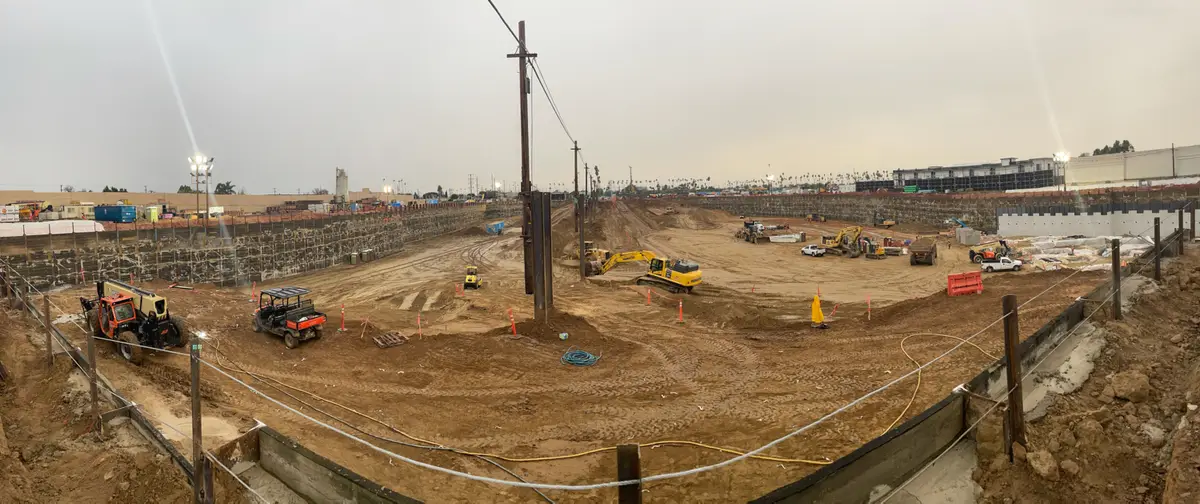
Tieback-braced soldier piles around the arena and cross-lot braces above truck traffic at the entrance tunnel.
Engineering scope
These projects show how excavation depth, neighboring structures, access, and the permanent work can change the support design. Your site needs its own geotechnical criteria and structural design. The contractor determines installation and construction means and methods.
Read more about tieback shoring or explore other published work in Inglewood.